
Icebound and Down
Plus: Worm Snails and Lightning Whelks

The Hudson River has been iced over for a week now, covered in frosty crags and gleaming plates that shift around all day, opening up and merging as they ride back and forth on the tides. It’s pretty beautiful, although it’s preventing my seal tours from running, which is getting me down. In addition to accounting for a fair amount of my winter income, those tours bring me a lot of joy. I look forward to seeing the seals and the seabirds all week, and to meeting everyone who comes out, so I’m anxiously watching the weather and hoping for some sun, and maybe a little chop, to break up the ice enough for the boats. If you were signed up for this weekend’s tour, I’m sorry it didn’t happen! The seals have been there all winter, and they’re amazing, so I hope to see you soon! If the freeze-out does drag on for much longer, I may end up offering some group nature tours along the water on cancelled dates, which you’ll have the opportunity to sign-up for.

In the meantime, I’m spending a lot of time along the icy river. Despite the wrench it’s thrown in my winter plans, I’ve gotta say, I find the whole scene pretty enchanting. The local bald eagle population has descended on northern Manhattan and every day, those wonderfully large raptors soar down to land on the ice and ride it back and forth. A birder in my neighborhood sent me a photograph of seven immature bald eagles waddling around on a shared plate of ice the other day.
Additionally, I’ve been dreaming, as one does in midwinter, of warmer days, sunny beaches, and pockets full of seashells.
When I started Landlubber, I planned to do regular newsletters about seashells, figuring I could draw on my large (perhaps excessive) collection for subject matter. I assumed that seashell profiles would be a good way to break up the longer emails with clean, short explainers, allowing me to write a few dispatches here and there that didn’t require a ton of research, or days of editing. I’d take a couple photos, write a few paragraphs, and hit send. Hell, I figured, I could probably knock off a few such pieces of writing on the subway.
Then, in the first seashell letter, I went way too deep on a single (admittedly awesome) shell my wife found on a beach in Costa Rica a few years ago and realized that maybe shell letters weren’t necessarily going to be as short and sweet as I thought. Maybe shell letters, like other types of letters, could be long, and difficult, and force me to run around looking up information that isn’t easy to find (like the murky, contested phylogeny of an obscure squid species).
I put off doing more for a while, but a few weeks ago, my wife travelled down to sunny Florida to visit her sister and found herself on famed shell-hunting grounds. She took a photo of a public sign that displayed some of the shells that wash up there, which, after an initial pang of envy, I treated like a menu, asking her to please keep an eye out for a couple of specific ones. She found them, so this week, I’m writing about…
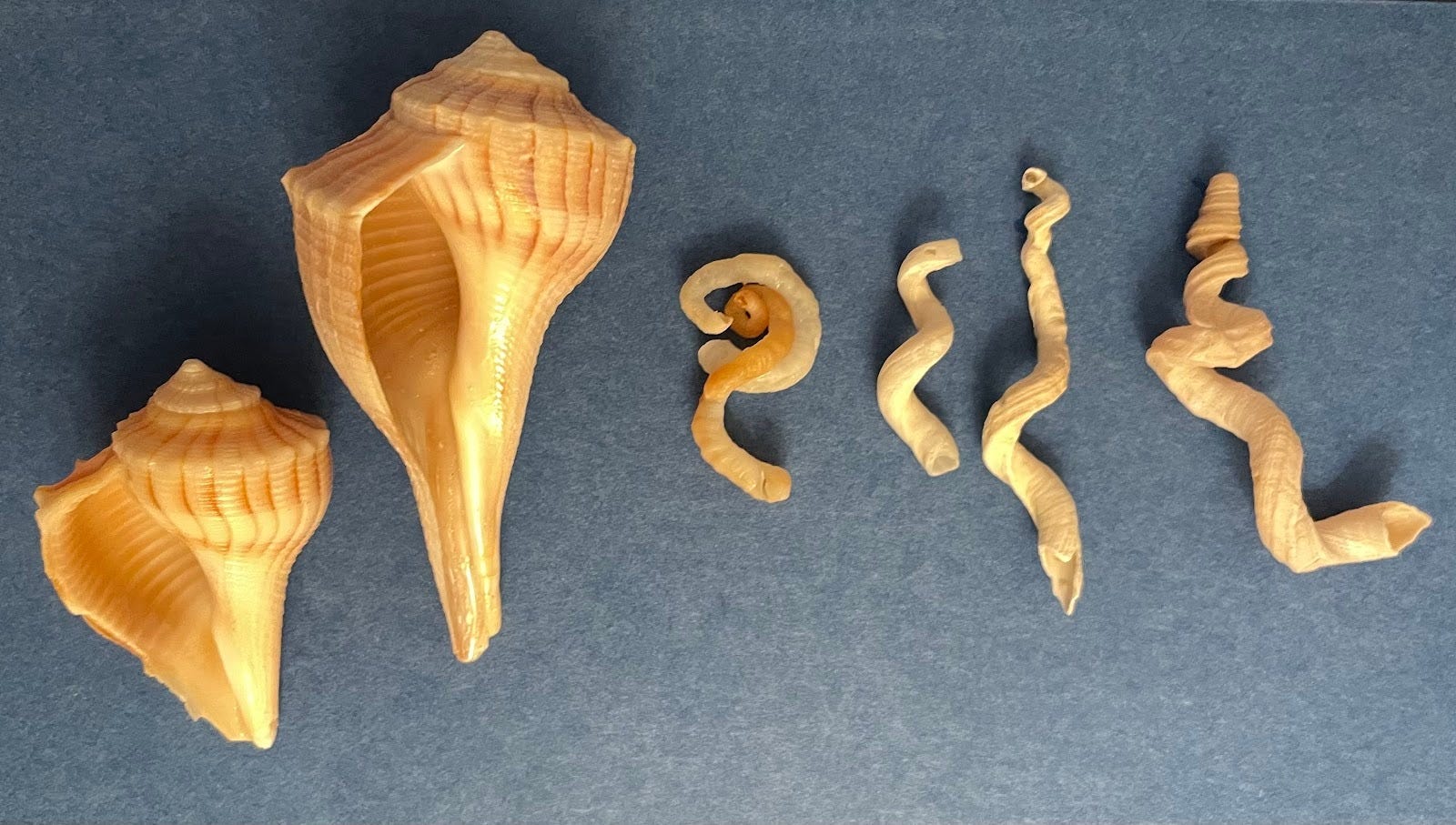
…Worm Snails and Lightning Whelks:
Gastropods whose shells curl against the grain, defying conformity
Worm Snails
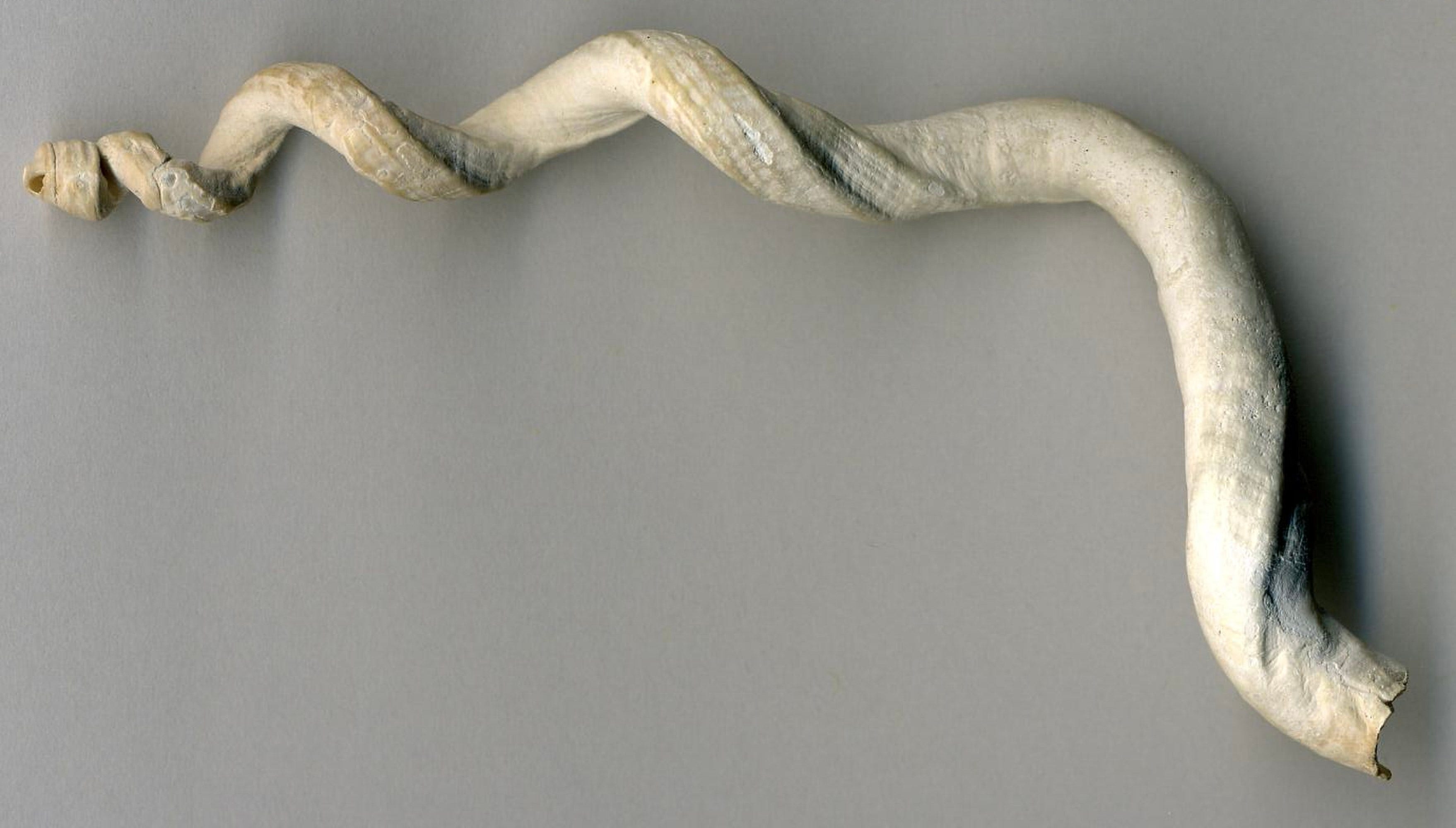
Worm snail shells are notable for their whacky corkscrewy-ness—a meandering, outside-the-lines growth that calls to mind… Salvador Dalí? Dr. Seuss? They’re weird!
They’re made by a group of snails in the genus Vermicularia, with species distributed fairly widely across the world’s marine environments (there’s a separate family of snails–Vermitidae–that are similar but in the interest of brevity, I’m going to ignore some taxonomy questions I have there for the time being). Two of these gastropods happen to live in waters around Florida—the Florida Worm Snail, and the Fargo Worm Snail. As the shells of the snails grow, they begin to leave gaps between sections, eventually uncoiling altogether.
At a first glance, worm snail shells don’t make much sense to me. If somebody designed a car, or a bicycle, or really any tool or device that looked like this, it would be pretty impractical. It’s not compact, or hydrodynamic, at least at a glance. It doesn’t look like it would serve very well as camouflage, or for defense. It’s also not very structurally sound. In a classical “closed coil” spiral—the tight kind you see in most spiral shells—each section of the shell’s chamber is braced against others, with all of them reinforcing each other. The worm snail’s shell appears to be free standing, vulnerable at every point, which is probably why so many broken segments tend to wash up on beaches where they’re found.
Furthermore, these odd shells lack some of the mathematical elegance that other shells exhibit. With worm snails, we leave behind logarithmic spirals, Fibonacci sequences, golden ratios, etc., and enter a chaotic world of disordered meandering. They look like scribbles you might make over a misspelled word. As Martin Sheen’s character says to Marlon Brando’s Kurtz in ‘Apocalypse Now,’ “I don’t see any method at all.” Nevertheless, worm snails evolved, generation after generation, to be this way, so there’s gotta be, if not method exactly, then at least some tangible organizing principle that can explain why they look like this, right?
This is the joy, to me, of shells and their architecture: each eccentricity is a little mystery, requiring us to imagine, piece-by-piece, the alien ocean world that animals inhabit. Some of those mysteries can only be solved with rigorous science: analysis of the mineral compounds at the microscopic level, or heat distribution properties (a surprisingly common explanation for various shapes and patterns seen on shells), but not all of them require that kind of professional effort. Some end up being intuitive—the kind of thing you can work out eventually just by looking at them and thinking. The ocean, seen this way, becomes a vast blue puzzle, where each little whorl of calcium carbonate is a puzzle piece.
The key to understanding worm snail shells is missing context—the unseen worm-snail sized hole in the ecological picture—which begins with the realization that they spiral out this way not so they can move more quickly, or defend themselves better, or subdue prey with them, or prevent themselves from drying out, but so they can stay put. Worm snails are among the mobile organisms that evolved, somewhere down the line, to become immobile, joining the barnacles, oysters, and other layabouts and hangers-on of the ocean environment that get by less through diligence and effort and more through real estate speculation. They begin their lives on the move, crawling across nearby surfaces like any old snail, but soon after, they settle on another sessile marine life form and weave their shells around or through that host substrate as they grow, cementing segments in place as they go. Each species of worm snail has evolved to attach itself to something different. Some imbed among fan corals, or brain corals, or porites, or marine sponges. A few simply attach themselves to rocks, or dead shells on the sea floor. Once in place, they engage in suspension feeding, casting a net of mucus into the water to trap organic material that drifts by in the current.
Lightning Whelk
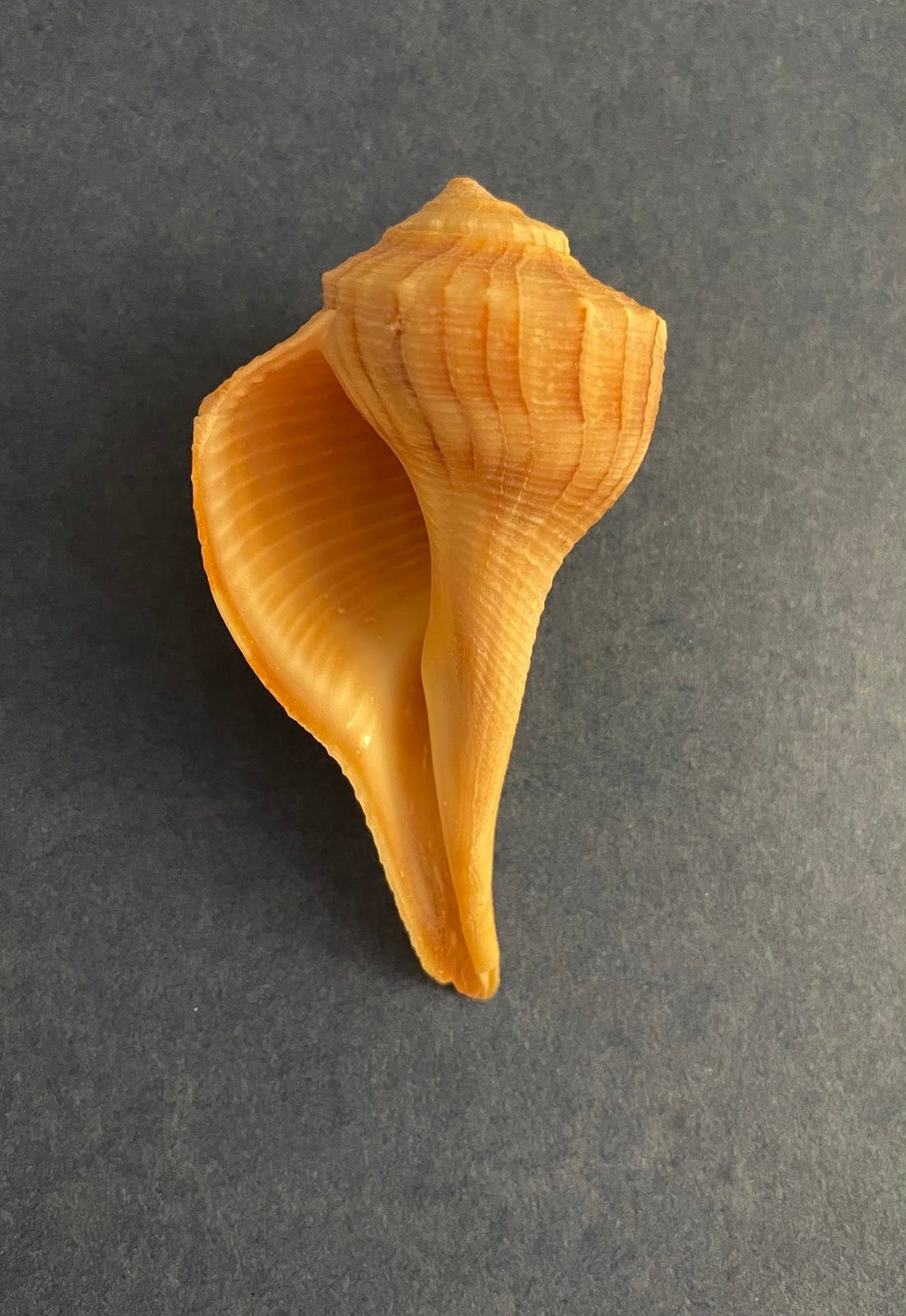
Hold nearly any spiral shell in your hand with the apex (the section with the tiniest, earliest spirals) facing up, and the aperture (the opening), facing you, and the aperture will almost always be on the same side, because the overwhelming majority of spiral shells in nature curl to the right. The lightning whelk is the rare exception—a sinistral shell in a dextral world.
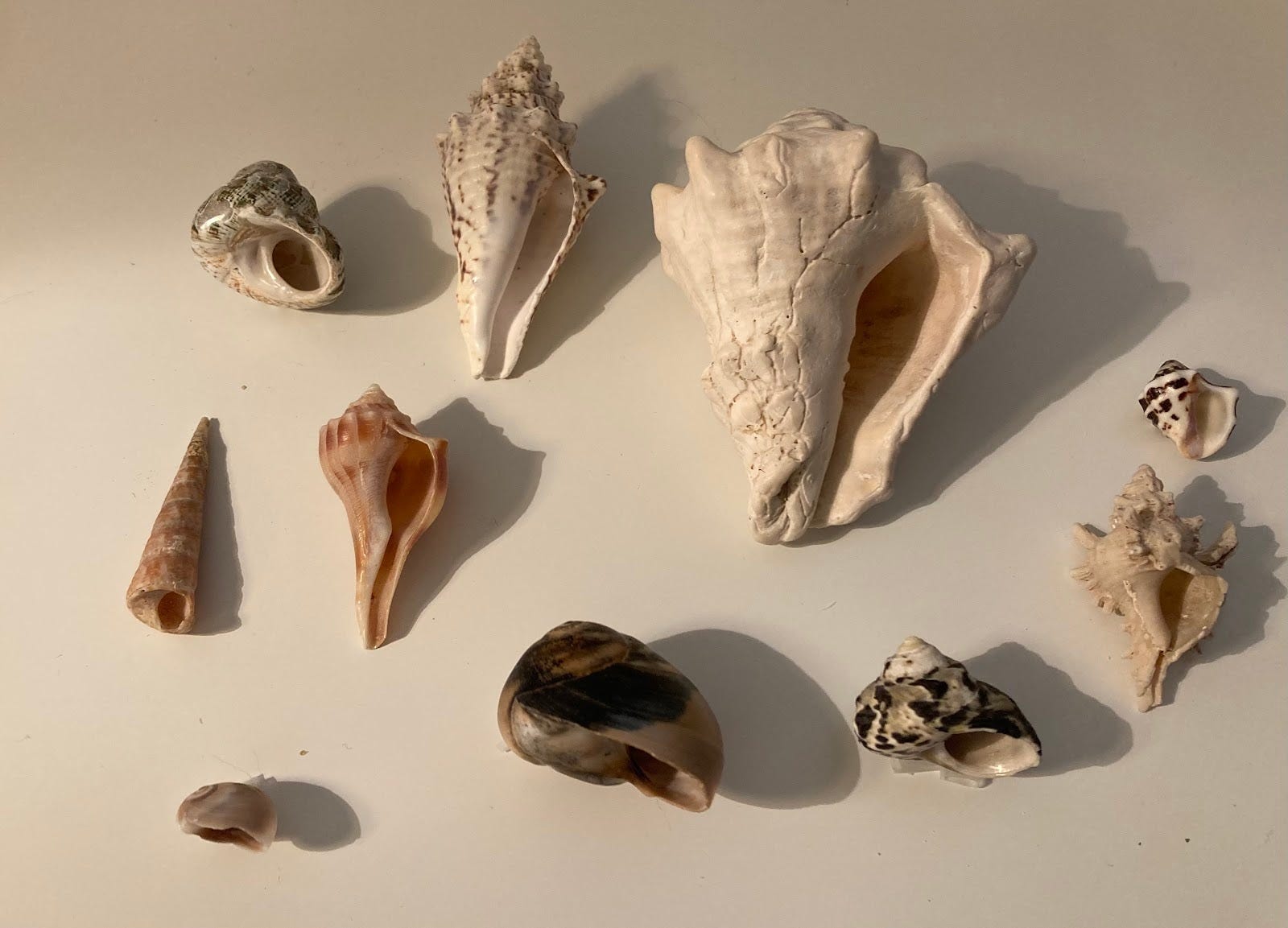
Why do all these shells curl the same way? I wish there was an answer as straightforward as the wobbly growth of worm snail shells, but the prevailing right-handedness of snails is a little more technical and murky, and requires us to consider the genetics of gastropod biology before we can work our way back to the fun ecology. It also requires a little bit of speculation on the specifics, which I’ll try to do in as informed a manner as I possibly can.
Genetics is a math-y level of biology that I’ve always been perfectly content to understand the broad strokes of without bothering much with the details, but basically, the chirality (spiraling direction) of gastropods depends on a single gene that in most species, expresses itself at the embryonic stage. In theory, this should mean that plenty of left-handed shells turn up in nature. Evolution is, after all, all about the mutations of genes. Organisms reproduce, genes mutate, and eventually, over generations, that process stumbles into genetic traits that confer advantages to the individuals that have them. As a result, those traits get passed down at a higher rate, eventually altering the species at the population level. Some traits require an entire sequence of genes in order to manifest themselves, which means that mathematically, they’re going to occur less often, but a trait that can be flipped with a single gene mutation is a little bit like a one character computer password. It’s the sort of thing you’d expect to see mutating relatively frequently, which means that when we don’t see it very often, it’s probably not an advantageous trait.
If I was just guessing, looking at snails and thinking about their environments, I’d assume that left-handedness and right-handedness were basically equally advantageous, and that even if, for some reason, being a righty snail increased your chances of survival a little, there ought to be some situations, just as there are in, say, baseball, where it’s better to be a lefty than a righty. I can easily imagine such a situation, at least in vague terms: an environment that because of the shape of the terrain, or the predominant angle of the sunlight, or the morphology of a common predator or prey species, or some combination of those factors, gives lefty snails a slight edge. So why aren’t there more left-handed snails?
One contributing factor is that it’s not just the shell of a snail that’s left-handed or right handed. The entire animal, soft parts included, tends to exhibit the asymmetry seen in the shell, and snails have evolved to reproduce with other snails whose bodies wind in the same direction as theirs. The diversity of gastropods means that this exhibits itself differently in different snails, but one example can be found in the many snail species with reproductive organs on the sides of their bodies. These snails tend to mate face to face, with their shells out, aligning the soft tissue on the sides where the reproductive organs are.
To understand why this could be a problem for snails with opposite asymmetries, consider two cars moving in opposite directions whose drivers want to stop to speak face-to-face in passing, or shake hands. The most practical way to do this is to pause with the driver-side windows up against each other. (If you’re having trouble picturing this, here’s a funny little clip from The Wire that shows what I mean, although I did make some low-resolution illustrations on my phone that are included below.) But what if the drivers’ seats are on opposite sides? Suddenly, this problem is more complex. If the driver of an American car, with the steering wheel on the left side, wants to roll down the window and shake hands with the driver of a British car, with the steering wheel on the right side, it’s not so easy for them to just stop as they pass. In fact, if the cars are meeting each other from opposite directions, it’s impossible to do this.
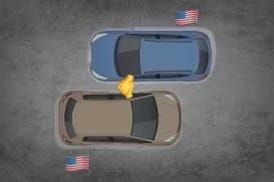
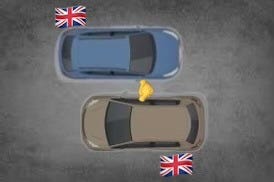
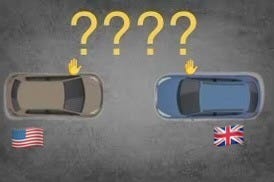
The hypothetical cars could, of course, just turn to face the same direction, drivers’ sides in, and shake hands that way (although incompatible symmetry can be sneaky: consider, for example, the directionality of human hands in such a scenario and you kind of stumble into a mini version of the same problem!) In nature, however, some lefty snails and righty snails seem to have trouble mating that way. One reason is probably that the large, heavy, rigid shells on their backs can interfere with one another, although there are a lot of shell shapes out there, and the degree to which they impede copulation is probably fairly variable. Some research indicates that this is a greater problem for snail species with wide, round shells. Other species, I should add, (although they’re the rare exceptions) are perfectly capable of perpetuating themselves with a mix of right-handed and left-handed individuals. Another factor that might prevent some snails from approaching one another from behind, or mating side-by-side (and this is speculation) is that lives of snails tend to be fairly violent. Their days are full of perilous encounters with other animals (often other snails) that sneak up from behind to try to suffocate them, drill into them, crack their shells, or swallow them whole. A preference for face-to-face mating offers some measure of security for an act that requires you to expose your soft tissue in a high risk environment.
There are other factors at play, some of them too technical for me to articulate well, but the outcome is that when the mutation to the single gene that controls snail chirality does occur, resulting in a lefty snail of a righty species, it rarely gets passed along, regardless of how successful the snail might be at its other life functions. Thus, right-handedness remains the rule.
The general predominance of dextral snails is a phenomenon that still attracts a fair amount of scientific interest. Evolutionary biologist Geerat J. Vermeij, in his very good book A Natural History of Shells, puts forward a few factors that he believes contribute, including a fairly technical discussion of torsion, which I’ve spared you from reading about here. As far as the conditions that allow sinistral shells to establish themselves in an environment where dextral coiling is favored, Vermeij elaborates on a couple of different factors that seem associated:
“What are these unusual circumstances that enable left-handed populations to become established? In a survey of reversals from right-handed to left-handed coiling that have occurred in marine snails during the Cenozoic era (the last 65 million years of earth history), I found that 12 of 13 reversals took place in lineages whose larvae emerge from eggs as crawling juveniles shaped like miniature adults, and that only one emerges as a swimming larva. The much more numerous reversals in land and freshwater snails also involve lineages lacking a swimming larval stage. I would interpret this to mean that the protective environment of the embryo growing inside a large food-rich egg is much more forgiving of alterations to the pattern of development than is the environment inside a small food-poor egg in which the embryo spends a short time before taking up life as a tiny swimmer. Those marine snail groups in which sinistral species have arisen all live or lived in sand or mud. Geographically speaking, seven lineages occur in cool-temperate or polar waters, and six are known from the tropical Atlantic. These environments, as well as those in fresh water and on land, may be less antagonistic to the establishment of oddities in shell geometry than are marine rocky bottoms or the many varied environments of the tropical Pacific and Indian Oceans, where no populations of left-handed species are known to have evolved during the Cenozoic.”
Fantastic writeup on these shells. The worm snail's shift from mobile to sessile is wild when you think about it becuase it's the opposite of what most organisms aim for. I've wondered if there's a specific trigger that makes them cement down or if it's more like a developmental window. The mucus-net feeding strategy makes sense once locked in place.
Loved today’s post, and the complete inability to do a short and sweet, low research post on something you love is deeply, deeply relatable 😂